Task 1 – Argument Structure
Aim: to understand how an academic argument is constructed, and how to create your own.
An argument examines a question, and is constructed from five components – point, evidence, analysis, critique, and evaluation.
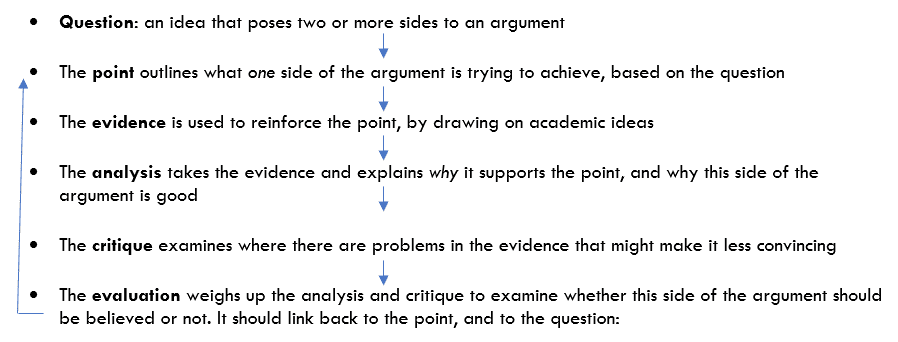
Stage 1:
Below, there are ten statements. Two are points, two are evidence, two are analysis, two are critique, two are evaluation for the question “Assess the view that the sky is blue”. You need to construct two PEACE paragraphs (one for each side of the argument) from them.
| Overall, there is a reasonably strong argument for the sky being blue based on our sense data | Our senses can fail us, such as when we dream, or hallucinate |
| Sometimes, we can see that the sky is not blue, but red, black, or grey, using our eyesight | We gain a posteriori knowledge from our senses, which we can generally trust |
| It can be argued that the sky is blue, because we can see it is blue with our eyes | If the sky is not always blue, then through a priori rational thinking, it cannot be logically described as ‘being blue’ |
| However, as it is sometimes blue, the statement is not technically incorrect – it is merely partially true | Overall, the argument for the sky not being blue is partially strong, but partially weak, depending on when it is observed |
| As we can see that the sky is blue, and we can trust our senses, it is reasonable to believe that the sky is blue | It can be argued that the sky is not blue, because it is not always blue when we look at it |
Stage 2:
Below, there are ten statements. Two are points, two are evidence, two are analysis, two are critique, two are evaluation for the question “There is no design in the universe”. You need to construct two PEACE paragraphs (one for each side of the argument) from them.
| William Paley used the analogy of a watch being clearly made by a watchmaker; thus, a complex world must have been made by a world-maker (i.e. God) | This suggests that life can adapt itself to its environment over time, removing the need for a God to have designed it |
| Overall, this argument has its strengths, but fails to provide adequate, convincing evidence | Overall, this argument is relatively strong, as it is backed up by empirical scientific evidence |
| There is an argument that there is no design in the universe | This would suggest that there is indeed a designer for the world, as our world is too complicated to have simply come about by chance, and therefore God must exist in order to create it |
| However, Dawkins’ theory can only explain what is seen in nature, and doesn’t address the issue of whether a God could have set evolution into motion as part of creation | There is an argument that the universe must have been created by God, as it is too perfect to have come about by chance |
| However, this world does not appear to be perfectly designed; as Mill would suggest – “a flawed creation suggests a flawed creator” | Richard Dawkins argues that evolution is a much more likely source of intelligent life than a creator God, as we can see the proof in natural selection |
Stage 3:
Now, create your own PEACE paragraphs for your own question, or one which has been set for you
Stuck? Go to https://youtu.be/T3XLFWLnfn4